
 |
|  |







 |
|  |



| |||||||||
| |||||||||
| |||||||||
| |||||||||
|
 | KAPITEL VIII <<< zurück vor >>> KAPITEL I KAPITEL / CHAPTER IX SKULPTUREN IN HANDLICHEN GRÖSSEN dazu EXPERTISE ARSEN FARADZHEV; MOSKAU----Fortsetzung von Kapitel VIII------- siehe unten! Weiter mit anschaulichem Fundmaterial, über das immer viel geschrieben worden ist, aber selten genug einem wissenschaftlichen Interesse für wert erachtet wurde. Damit erstmals im Fundzusammenhang aus einem relativ begrenzten Aufschluß von mindestens 20m Tiefe, hier nun einem größeren Kreise von Interessierten optisch zugänglich gemacht wird. Translation: Sculptures in handsize and EXPERTISE FROM ARSEN FARADZHEV, MOSCOW continued from chapter VIII -----below------- sampled material, always more speculated about in writings, but seldom published from a relatively large area and deep layer of at least 20m below ground level.
Ausgangsmaterial, die "Naturknolle" aus Flint/ The natural flint nodule as basic shape selected.
Eine natürliche Flintknolle halbiert und als Büste gestaltet. Vergleiche dazu auf Kapitel V, Foto 61 und 61a weitere kleinere "Büsten".Transl.: Here a natural flint nodule used to "create" a bust size sculpture.
Flintknolle mit minimalen Gestaltungselementen wie Frontalansicht eines Tierkopfes mit Nasenöffnungmarkierung. Flintnodule showing minimum markings presenting an animals head in "Frontview" with the nostrils depiction only.
Transl. Photo #4a is the same object turned to present view from top, showing now a pair of eyes and the nostrils depicted as well as the side of the head shaped into this possible bear head.
Mögliches/ possible "Spitzmaul"-Nashorn auf der Abschlagseite/cortex removed part/ sitzend/ sitting position. FOSSILIENfunde belegen für Schleswig-Holstein das "rosenfressende" Nashorn schon vor MINDESTENS 100 000 Jahren. Beim Bau des Nord-Ostseekanals wurden zwischen Grünental und Odenbüttel zwei Nashornzähne gefunden, in deren Gruben noch Futterreste saßen.(Rosenstacheln) (Quelle; undatierte alte Zeitungsmeldung).Transl.:" Fossil finds of the Rhino" in Schleswig-Holstein, during building activities of the North-Balticsea channel. Two rhinoceros molars with food leftovers( Rose thorns) reveal, the existence of this species in this part of the country MINDEST DATING 100 000 years ago. KOPFDARSTELLUNGEN UND VOLLPLASTIKEN MIT MATERIALENTFERNUNGEN UND GESTALTUNGSSCHWERPUNKTEN
Bei diesem Tierkopf ist ein Auge durch eine "natürliche Öffnung", aber das Maul bereits mit gekonnter Technik des Feuersteinbearbeitens dargestellt. A natural cupule indicates the eye but an advanced technique presents here a slightly opened mouth of this animals head. Compare this feature also on the next sculpture.
Gestaltungselement schwarz/weiß Kontrast über natürliche Kortexfärbung mit Schwerpunkt auf Kopfgestaltung und geöffnetem Maul (mögliche Eisbärendarstellung.) Transl.: Flintnodule selected for a possible polar bear depiction in black flint and white cortex contrast.
Große Flintknolle mit natürlichem Loch als "Einäugig" gestaltet, mit aufgerissenem Maul erinnert es an ein "Fischmaul". Eine weitere Knolle( nächstes Foto # ) trägt mehrfache Gestaltungselemente, gezeigt ist hier nur das menschliche Profilgesicht. Transl.: larg flint-nodule incorporated here a natural hole to represent the known "one eye" feature of some sculptures, but the wide open mouth reminds of a " fish head." Head in profil is the next flint nodule styled see photo # below. It has multiple elements depicted all over.
Halbseitiges Gesicht im Profil aus Quarzgestein mit Farbanhaftung.Profil face with Color-traces.
Das gleiche Motiv mit rückseitiger Farbanhaftung in Sandstein. Vergleiche nächstes Foto. / Trans. A similar motif depicted in small, sand stone with colour-traces.
Kopfumrissform eines Bären, sehr verschliffenes quarzitisches Gestein
3 unterschiedliche Materialien Feuersteinabschlag, Basalt und Granit im Vergleich. Transl.: 3 different stones in comparison, see also below.
Ein andere Bärenart mit nur teilweise alter Kortexverwendung, hier herzförmig.Transl.: A different bear species using an old white cortex to depict a "heart shape" on a grey type of flint. For head shapes study the following 2 photos.
Vorderseite Bär/ frontview bear
Rückseite: Großkatze. Cat like impression on this side.
Bär, Art unbekannt. bear, species unknown
Wiederholung von Posen, hier "sitzender Bär."aber anderes Gestein./ Transl.; sitting posi-tion of an animal repeated here in different stone- material. Compare for "bear" interpretat.
Junger Wisentkopf aus braunem Flintgestein.
Vogelform: bei dieser Skulptur ist der große" Schnabel" ein "Abschlag".Ein anderer Gestaltungseingriff ist an der folgenden Skulptur zu erkennen./ This bird sculpture carries a larger flake to indicate the birds beak. Different technique is used on the following sculpture.Here some holes are left" natural" or worked, compare all three objects carrying various traces of workman ship.
3 Tierköpfe, Vordergrund ein Pferdekopf erkennbar am gestreckten Hals, links Löwenkopf, rechts: möglicher Hundekopf mit Ohrenandeutung/ Transl.: 3 different animals head. Front: horse head indicated by the long neck, left: "lions" head, right: canine type of animal head, indicated by " pointed ear".
Tierkopfreihe auch auf plattenartigen großflächigen Flintabschlägen oder anderen Gesteinsarten. Interpretationsversuche; Kartzenartige wie Löwenkopf(Lions head), Jungtier Wisent, Vogelform ,Pferdeköpfe, Schildkröte u. Nashorn.
Quarzitische Schildkröte: siehe dazu weitere Ausführungen über "portable art Objekte" aus der USIPP-Congress Präsentation vom Moskauer Experten Arsen Faradzhev, PhD
PAGE 5 continues in text/ Fortführung mit der Textseite Nr. 5 aus dem Lisbon, Portugal 2006 Papier von A. Faradzhev: A big difference from this tool type group is a turtle artifact with the catalog number is Tor. - 0,001 made from the same spotty flint material (Fig. 5-8). The longest line of this artifact is 18,5 cm., widest part is 10,5 cm. and the heights one is 8,5 cm. (Fig. 6).
There are three obvious exceptions separating the portable art image from any other tool of the collection. The first one is two different ends of this artifact. Therefore, the artifact has unequal parts – a light part and a heavy one (Fig. 5). They looks like an obtuse, wide and heavy end on one side and narrow, long and light end on the opposite side. The heavy part is consisting of two three-dimensional surfaces – the upper and the lower one, united by the perimeter line of 27 cm. in length.
The upper surface of artifact heavy part is counting three facets. Two of them are 10,5 cm. long and around 5,5 cm. wide. The third facet on the upper surface is 9 cm. long and only 3 cm. wide. The lower surface consists of three facets as well – two of them are around 15 cm. long and approximately 7 cm. wide and the third one is 9 cm long and 6,5 cm. wide.
The second exception is the location of two hypothetical internal flatness parts standing in perpendicular to each other. Moreover, the third important exception is that the spotty kind of flint material is marking the overall appearance of the portable image.
The flint stone artifact catalog number is F-0,002 looks like the upper part of a truncated cone 7 cm. in diameter. It is empty inside and therefore it is possible to see that the thickness of the walls are around 1,5 cm. with three natural holes – one at the top of the flint cone, 0,8 X 1,3 cm. wide and two holes are coming from inside to the outside surface. Their outside diameter are just 0,5 cm. wide.
It is metamorphosed sandstone with catalog number F-0,001, 19,5 cm. long, 6 cm. tall and 2,5 cm. wide. It is flat from one side and artificially designed from the other. One end of this stone designed as part of an arch 12 cm. And is from 0,5 to 3 cm. wide. It is around 9,5 cm. along the straight line from the beginning till the end of the arch line. The upper line is designed to create some kind of the slope 10,5 cm long and 4 cm wide from the same end. The red color line is starting at the middle and continues by 8 cm. and 4 cm. to the bottom of the artifact. There are more than ten flakes along the designed side of this sandstone artifact. Therefore, all those evidences allowed me to consider this artifact as sandstone fish portable image. Conclusions. The act of Palaeoart creation is in itself already a unique exception from all other possible kinds of human selections and the Palaeoart research seems to be also a selection process. The researcher prehistory time either coming from some institute or being a private collector selects the images, site, the approach, methods, and evidences and so on. Moreover, for each, it remains an individual selection, often governed by a person private judgment applied towards creation. Nevertheless, it reflects also a very personal feeling towards art. Again, this is the same for everyone either being an institutional or private researcher and a key point at the same time. It is similar to musical “feeling” and understanding of tunes not always heard with a “perfect ear”. Regardless, the researchers do have to present their “scientific evidences” of their investigation in a proper way and such can be expected in general from the institutional researchers having been trained to present the basis of research (Allakhverdov 2005, p.49), so as if it is some kind of scientifical approach even on a minimum basis. Here in this particular case the German Institutes and their scientists ignored the importance of a reported fireplace, which can be helpful to obtain direct datings for possible artifacts found in the vicinity. At least assisstance of a specialist should have been accompanying this sampling procedure of layperson, instead simply refusing the overall material. The private collectors are spending many years of handling their stones. However, the experts are coming for few days and other just few hours to see and select something from the collection, which cannot give enough time to see a reasonable minimum part of the stones. The few examples of portable art artifacts, which I consider in this article, are showing that in a future it could be much more of them. One of them is giving indirect date. The portable image of the turtle is belonging to pre-glacial fauna. The selection process is a key point concerning the Palaeoart as I try to show in my article, but it is not a Palaeoart images problem. It is a matter of human choice. Acknowledgments I am grateful for the invitation to present article at the symposium C26 and particularly grateful to Ursel and Helge Benekendorff for the financial support and great honor to work twice during 2006 with their private collection and for the possibility to participate on the Lisbon Congress 2006. I am deeply grateful to Ursel and Alan Benekendorff for their assistance of writing this article and for flexibility and patience during long and intensive discussing and research of the artifacts of private collection artifacts. REFERENCES ALLAKHVERDOV, V., 2005. Splendour and Misery of Empirical Psychology: Towards a Methodological Manifesto of Petersburgian Psychologists, PSYCHOLOGY, the Journal of the Higher School of Economics, pp. 44-65. FARADJEV, A. 1999b. Metaphysical opportunities as a tool of rock art research. In NEWS95 – INTERNATIONAL ROCK ART CONGRESS, North, East, West, South, 1995 IRAC. PROCEEDINGS, Volume + CD-ROM (Symposium 1A: New approaches, part1, theory – ), IFRAO – INTERNATIONAL FEDERATION OF ROCK ART ORGANIZATIONS, pp.46, PINEROLO, ITALY.
|
 Foto 1
 Foto 2
 Foto 3
 Foto 4 Büste eines Tieres / bust size sculpture of an animal
 Foto 4a gleiche Büste in veränderter Position mit Ansicht von oben, hier werden 2 Augen und Nase sowie eine seitliche Kante bearbeitet. Möglicher Bärenkopf
 Foto 4b Rückseiten-Ansicht, back view impression
  Junges Nashorn/ Baby rhinoceros Foto 5
 Rückseite: Alt-Tier Nashorn/ old type rhino on back side Foto 5a
 Kopfstudie Foto 5b
 Impression of head and horn. Foto 5c
 sitting position on flat surface Foto 5d
 Foto 6
 Foto 7
 Foto 8
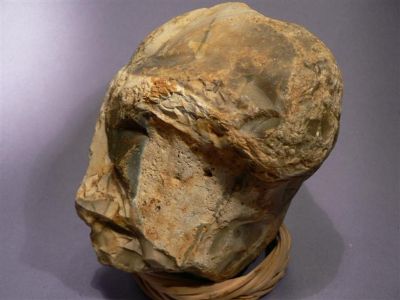 Foto 9
 Foto 10
 Als " Säule" mit Profil hat diese einäugige Impression eine lange Nase und Mund. Sie trägt einen "Bären" als Tierkappe. Gr. 22,5 cm Rückseite siehe nächstes Foto Transl.: An upright stone slap of 22,5 cm hight, bears a human profile and carries a "bear-cap", see next photo for back side impression.

 same object like above back-side impression with color traces.


 Foto A
 Foto B


 Fig. 5
  Fig. 6
 Fig. 7

